
Going For It: Life-Long Learning in my 50s at an Age-Friendly University
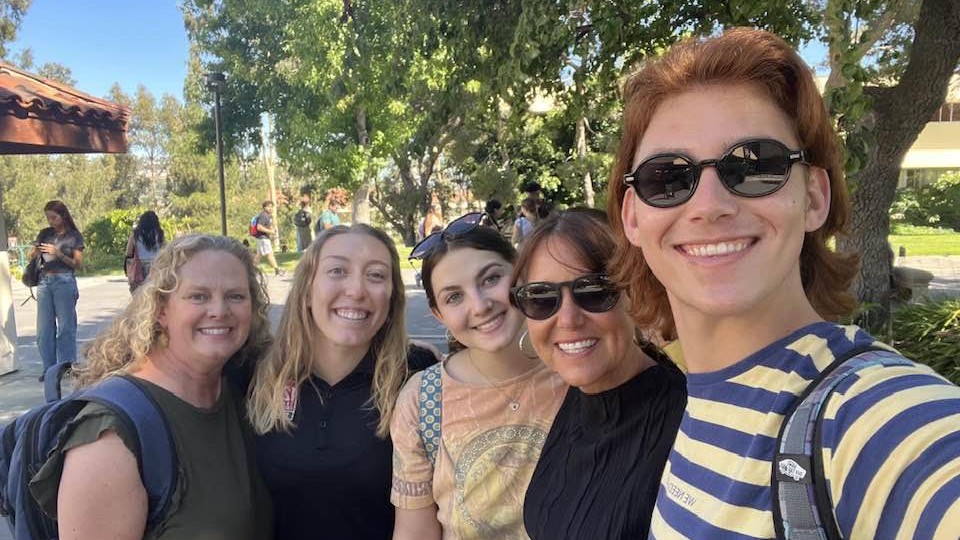
By: Heather Robert, Graduate Assistant, SDSU Social Policy Institute
As I reflect on October’s Age-Friendly University Month, I’ve been thinking about the AFU mission—to create a campus culture that values learners of all ages, supports diverse life stages, and promotes inclusion across generations–and my own experience the past few years as a “non-traditional age” student. This mission encapsulates some of my core values–lifelong learning and intergenerational relationships.
I had a long break between undergrad and grad school (over 25 years), but I’ve been a perpetual student, in one way or another, the entire time. Sometimes it was in the form of professional development for a job—necessary when you were a double-major in political science and religion and find yourself doing marketing for a Fortune 500 company–or specialized training for volunteer positions like learning how to cuddle babies in the NICU, provide emotional support to patients on hospice, or write court reports as an advocate for foster youth. Sometimes it was lessons in singing, ukulele, drumming, art, or meditation to feed the soul. Many times it was university extension classes that let me do the reading, writing and “big thinking” I missed so much from my college days like a philosophy class on Albert Camus here or a journalism class on the art of interviewing there.
As far as intergenerational relationships are concerned, I’m what you might call a compulsive connector. The toddler in the shopping cart in front of me, the old woman sitting next to me on the plane, the middle-aged guy standing next to me waiting for the band to go on–we are going to have a conversation. One of my driving beliefs is “A stranger is just a friend you haven’t met yet,” and I’m filled with benevolent curiosity about people’s lives. What makes you laugh? What makes you mad? What are your joys, sorrows, fears? What do you care about? How are we the same and how are we different? We bond over where we intersect and learn from each other where we don’t. And, in that way, of course, relationships are a crucial element of lifelong learning.
However, despite my seemingly inherent “good fit” for pursuing formal further education, when I submitted my application to the Master’s in Social Work program at SDSU two weeks before I turned 50, I wasn’t sure I’d actually enroll if I was offered admission. I was filled with fears and insecurities about going back to school at this age.
The spiral of self-doubt really set in. How can I possibly add school and studying to my already precarious work/life balance? Is it selfish of me to be considering a completely new career when becoming a full-time family caregiver is on the not-too distant horizon? Is it foolish to think I’ll have adequate time or mental capacity to study and absorb the material? Will I feel socially isolated from my much younger classmates? Will I make friends or will they think I’m ridiculous? I’ll be nearly 55 when I graduate…will anyone hire me or will potential employers think I’m irrelevant or not worth the investment? Will I regret grad school as a big waste of time and money that kept me from spending time with friends and family? Was this risk worth the leap?
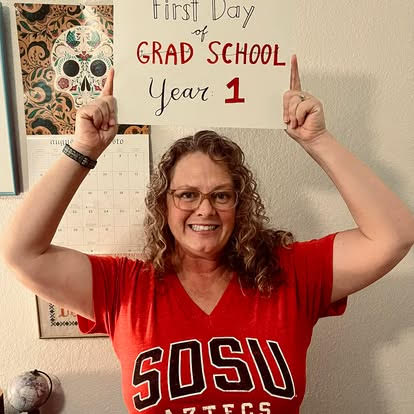
I realized how much I appreciated my own intergenerational relationships–the deep connections with people significantly older than me, the laughs and losses we’d shared, the mentoring and wisdom they’d provided.
I had an a-ha moment.
Now I had the opportunity to be the older half of new intergenerational relationships.This shift helped me feel more comfortable and confident as a “non-traditional age” student. It helped me feel like I belonged and had value to offer my cohort. So, here I am, just about two-and-a-half years into my four-year MSW program—and I’m loving it. I adore my classmates. They’re insightful, passionate, good-hearted, and definitely more world-wise than I was in my 20s. We study together, laugh together, complain together, support and encourage each other. I’ve come to regard many of them as true friends. I hope they’ve learned some things from me; I know I’ve learned so much from them.
In fact, I’m learning all over the place! From my professors, lectures, projects, papers, research, internship and, currently, a really cool graduate assistant position. I feel like I’m absorbing so much now compared to my undergrad experience.This time around, I have a more extensive “catalogue” of lived experiences to draw from. I’m able to connect abstract concepts and theories more readily with real world experiences from my accumulated relationships, jobs, mistakes, traumas, and triumphs. I’ve connected to the material, I’ve connected with my peers and professors, and I’ve connected with this age-friendly university. I’m seeing pathways to my future “encore career.”
How it all unfolds is yet to be seen, I’m so proud and grateful I took the leap.